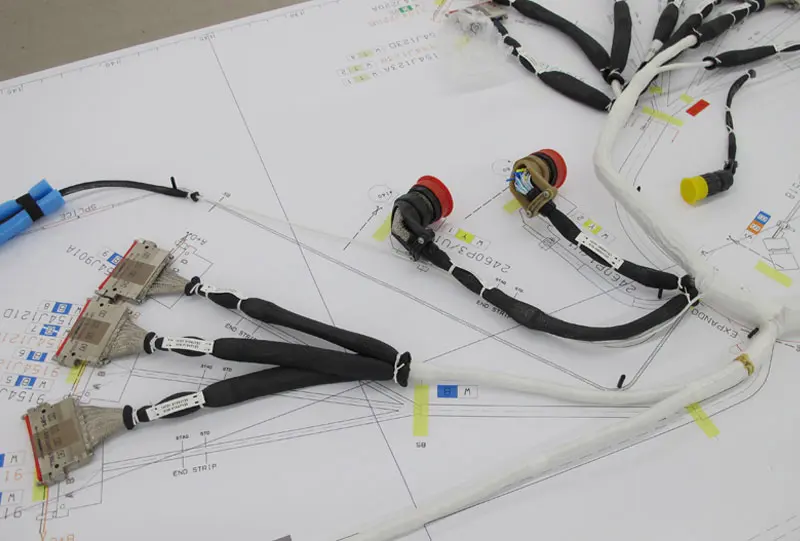
Closed Bundle and Overmold Electrical Harness Configurations
This article is a continuation of our wire harness construction series. As a follow up to our previous article on Wire Harness Construction and Open Bundle Configurations (Click here to read Part 1), the following will discuss the characteristics of the closed bundle and overmolded harness designs.
Closed Bundle Wiring Harnesses
Closed Bundle vs. Open Bundle: While layup, wire preparation, and termination are much the same, the primary difference between the two configurations is the use of an outer braid or protective sheathing. As the name implies, the cable jackets of the closed bundle harness are secured within an over braid or other protective material. While the open bundle design offers greater repairability, the closed bundle offers improved durability. During the layup process, the wire cables can be twisted together during the branch bundling, which gives the harness added bend and flexibility.

Although closed bundle harnesses typically have limited repair options, their configuration is ideal for hostile environments. Harness branches are enclosed with materials that protect the inner wire jackets and conductors from mechanical damage and electrical (EMI) compromises. The outer protection can consist of a variety of materials. Outer sheathings include heat shrink sleeving, conduit, tubing, or spiral wrap.
Over braiding is another option that offers exceptional protection. Over-braiding includes metal, Nomex®, PEEK™, Kevlar®, and other protective materials.