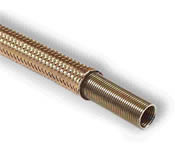
Duraflex® Type C-3 Pressure Tight Flexible Metal Conduit
Duraflex® C-3 is an extremely flexible, convoluted, pressure tight metal conduit which exhibits prolonged resistance to vibration, heat, and pressure
Features:
The single layer of 2 over 2 under fine bronze wire braid restrains axial pressure and provides maximum protection.
Application:
Radio Frequency Shielding, Low Temperature Protection of Electrical Wiring, Abrasion Resistance, Corrosion Resistance, Non-Sparking, and Electrical Continuity.
Construction:
Innercore - Brass; Braid - 1 Layer Bronze Fine Wire; Braid Weave - 2 over x 2 under
Fittings:
Customers may specify from a wide range of fittings to satisfy electromagnetic hermetic sealing, high temperature, self-locking, or other requirements. Typically, end fittings for industrial applications are made of brass; however, more severe operating environments may call for fittings constructed of other materials.
Part Number | I.D. NOM | O.D. NOM | Working Pressure (psi) | Weight LB / FT | Minimum Bend Radius |
C12-3 | 0.175/0.190 | 0.305/0.320 | 3,800 | 0.083 | 1-1/8 |
C16-3 | 0.235/0.250 | 0.385/0.400 | 2,450 | 0.129 | 1-3/8 |
C18-3 | 0.285/0.300 | 0.435/0.450 | 2,310 | 0.144 | 1-1/2 |
C20-3 | 0.313/0.328 | 0.465/0.480 | 2,600 | 0.152 | 1-3/4 |
C24-3 | 0.360/0.375 | 0.510/0.525 | 1,900 | 0.166 | 2 |
C28-3 * | 0.425/0.440 | 0.590/0.605 | 2,000 | 0.211 | 2-1/8 |
C32-3 | 0.485/0.500 | 0.658/0.673 | 1,400 | 0.227 | 2-1/4 |
C40-3 | 0.610/0.625 | 0.780/0.795 | 1,000 | 0.303 | 2-3/8 |
C48-3 | 0.735/0.750 | 0.905/0.920 | 800 | 0.353 | 2-1/2 |
C64-3 | 0.985/1.000 | 1.210/1.225 | 890 | 0.605 | 3-3/4 |
C72-3 | 1.141/1.156 | 1.360/1.375 | 700 | 0.683 | 4-1/2 |
C88-3 * | 1.350/1.375 | 1.615/1.630 | 380 | 0.804 | 5 |
C96-3 * | 1.485/1.500 | 1.747/1.762 | 300 | 0.877 | 5-1/2 |
| (1) * denotes special size. (2) Run lengths over 25 feet are special order. (3) Depending upon requirements, Duraflex product can be sold at cut or random lengths. (4) Working pressure ratings are based upon 70°F (21° C) and uniform pressure environments. (5) Working pressure characteristics will be reduced at higher temperatures. (6) Working pressures will vary based upon end connections. | |||||